Company
Boeing
Product
Competency Viewer | CBTA | LMS
Timeline
2023–2025
Domain
Aviation Training | Assessment & Performance Tracking
Problem
CBTA had a regulatory framework. No digital tool existed to assess and track competency in practice
Approach
Research with real ATOs to understand where manual workflows were failing instructors at scale
My role
UX Lead on Competency Viewer, content team contributor, research participant with ATOs.
Solution
1–3h of manual PDF reporting per session replaced with structured digital tracking, down to 20 minutes.
01 Context
Why CBTA is different, and why it’s hard to implement
Traditional pilot training was built around tasks. Complete a procedure correctly, pass the check, advance. Whether the pilot could adapt under unexpected pressure wasn't really the point.
Competency-Based Training and Assessment changes the question entirely. ICAO, IATA, EASA, and the FAA have all moved toward competency-framed training over the past decade. Boeing's 'Building Resilience' framework defines nine core competencies with specific observable behaviors. The framework is thorough. What it doesn't contain is a workflow.
Official references
02 Background
Content experience as domain knowledge
Before the Competency Viewer existed as a product idea, I spent years working inside the CBTA content ecosystem at Boeing Training Solutions. As part of the content team, I helped lay the foundations for the Supplementary Library: design guidelines, content architecture, and the structural logic separating formative scenarios from summative assessments.
That work was learning how CBTA actually works. What an observable behavior means in an assessment context. Why the language in a report matters. By the time the Competency Viewer became a product question, I wasn't coming to it from the outside.
03 The Problem
An hour per student, every session, in a PDF
Two flight schools. Two very different operations. The same problem.
These were partner ATOs in Boeing's publicly announced CBTA Learning Library collaboration: Leading Edge Aviation in the UK, one of four ATOs selected globally and the only UK-based one, and Atlantic Flight Training Academy (AFTA) in Ireland. One was running hundreds of cadets with new students onboarding every month. The other ran KSA-100 assessments individually alongside experienced airline captains. Both relied on PDF forms, handwritten notes, and scanned reports uploaded to flight loggers. Both spent one to three hours of writing per cadet per session. Neither had any aggregated view across a cohort.
The concern wasn't whether CBTA was valuable. It was whether anyone had the bandwidth to implement it properly.
04 Research
Two sessions, two countries, the same conversation
In March 2025, I participated in research sessions with both schools. Mixed teams on both sides: training managers, chief instructors, KSA assessors, compliance managers, experienced airline captains.
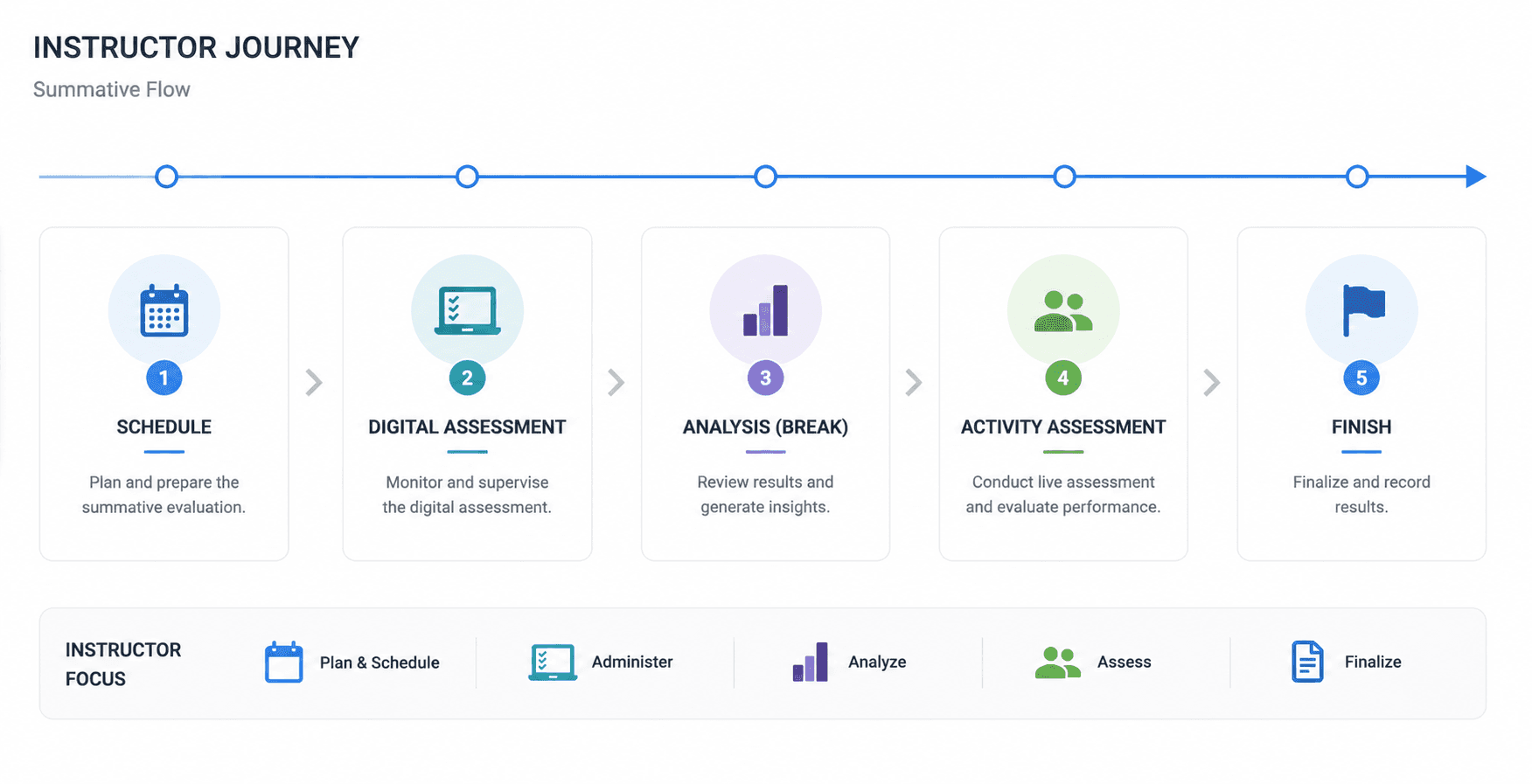
Recreated conceptual flow. Product names, operational details, and implementation specifics have been anonymized or generalized to protect client confidentiality.
05 The Platform
The LMS had been built for admins. Learners needed something else.
Alongside the Competency Viewer, I led a structured UX review of the Jeppesen Learning Center, the Cornerstone-based LMS delivering CBTA content to students. It worked technically. Experientially, it had been built for administrators rather than learners.
The audit covered ten component areas. Findings were specific: unnecessary dropdowns, the same page reachable from four differently-labelled buttons, support contacts as primary homepage content. The redesign stayed within Cornerstone's existing capabilities. Same platform, different priorities. This was the same training ecosystem, and many of the same learner-versus-admin tensions, that I would later take on at a larger scale in Boeing Learning Solutions (Case Study 04).
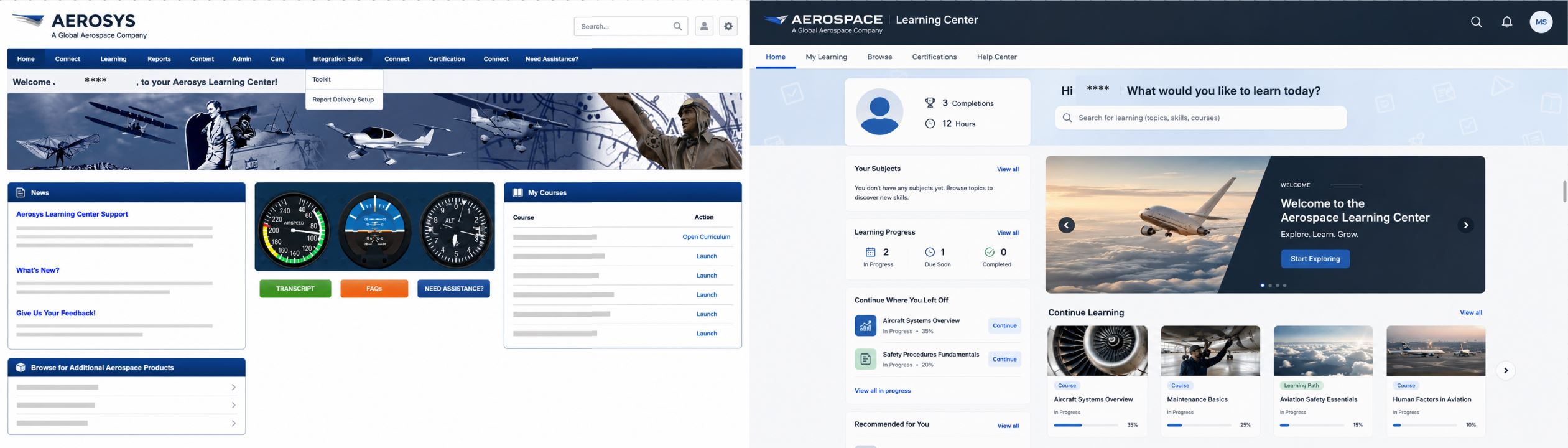
Before and after. Left: the legay homepage, equally designed for both: students and administrators. Right: redesigned student view, optimised for what learners actually need on arrival. UI Recreated for portfolio purposes.
06 Outcome
Research that shaped a product direction
The headline number is the most concrete outcome. Instructors were spending between one and three hours per cadet on post-session reporting, multiplied across cohorts in the hundreds. The Competency Viewer projects bringing that down to 20 minutes per cadet by removing manual rubric work, surfacing competency status at a glance, and generating compliance-ready PDF reports. The figure was modelled with both schools against their real workflows and confirmed as realistic by both training managers.
Beyond the time saving, the research produced concrete direction for the product. Overview-before-drilldown became a structural requirement. Status cues and report language were treated as developmental rather than pass-or-fail. And reporting had to fit each ATO's existing record system, producing compliance-ready output without forcing instructors to report twice.
Adoption is moving beyond the first two schools. In March 2026, Boeing CBTA experts ran a seminar with Thai Inter Flying and the Civil Aviation Authority of Thailand, an early regulatory engagement in Southeast Asia. What started with two flight schools in the UK and Ireland is reaching training organisations across new markets.
Early Adoption
Thai Inter Flying: Boeing CBTA seminar with CAAT, March 2026 ↗
Civil Aviation Authority of Thailand: CBTA engagement, March 2026 ↗
Official Resources
20 min
projected instructor reporting time per cadet, down from 1–3 hours
3
ATOs committed to next steps: working sessions, video testimonials, EATS booth. Additional opportunities in SE Asian market
100s
of active cadets across the two schools, all tracked manually before
01

02

What it took
The value didn't come from desk research. It came from putting rough wireframes in front of real instructors early and letting their reaction set the direction. The domain depth made the sessions productive, but the discipline was treating our hypotheses as questions to validate, not conclusions to defend.
The clearest lesson is that the multimedia and content years weren't a detour. They were what let me ask the right questions when it counted, and recognise a real answer when an instructor gave one.
07 Reflection
On why domain knowledge is a design tool
You can learn a domain after the fact, but you can't fake the intuition that comes from having worked inside it. The ATOs recognised it immediately, in the questions I asked and the answers I knew to listen for.
It's also why I don't treat domain knowledge as a nice-to-have. In a field this specialised, it's what separates a tool built around how the work actually happens from one built around how an outsider imagines it does.