Company
Jeppesen ForeFlight
Product
Analysis Workspace - KPI-Driven Optimization
Timeline
2025–2026
Domain
B2B · AI-assisted UX
Problem
Users know the outcome they want but not which of 2,000+ parameters to touch
Approach
Invert the planning logic: KPI targets first, system proposes parameters and ranges via surrogate Machine Learning
My role
Senior Product Designer
Problem reframing
Leadership & portfolio alignment
Roadmap & phasing
Validated direction with customers
Solution
Projected ~80% reduction in configuration time. Four product teams aligned behind one direction
00 Context
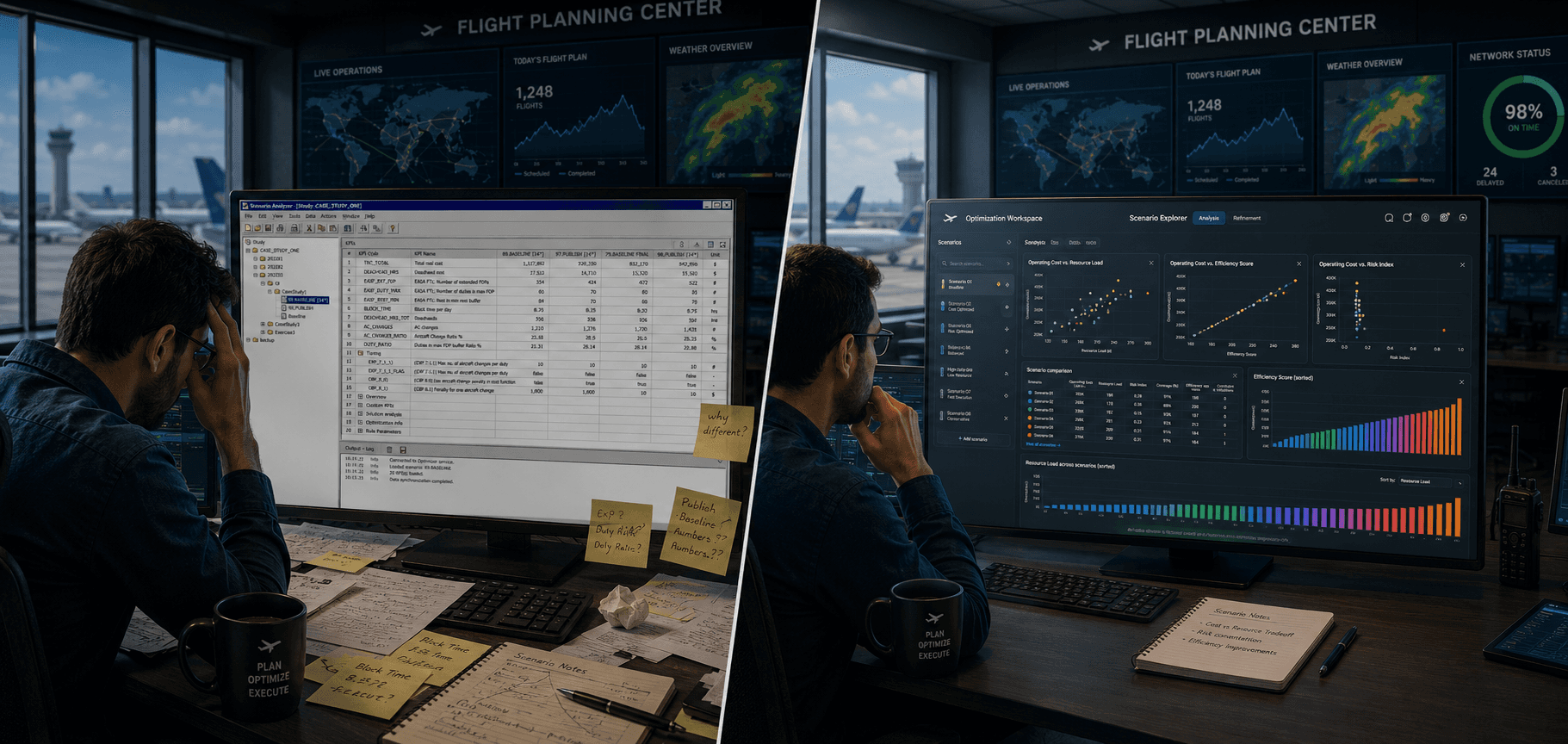
This is the second phase of a larger redesign of a crew planning platform. The first phase rebuilt how planners compare scenarios and decide between them. This phase tackles what sits upstream of that decision: how they configure the optimizer in the first place, from a list of over 2,000 parameters.
The full Phase 1 story is its own case study: Analysis Workspace.
01 The Problem That Remained
Templates solved reuse. They didn’t solve the knowledge gap.
2k+
configurable parameters with no system guidance on which to tune
1–5
parameters typically tuned per session, regardless of user seniority
87%
of users relied on help or experimentation to find the right parameters
Analysis Workspace has given planners a way to compare scenarios and launch multiple optimizer jobs in parallel. That removed one layer of friction, but left the deeper problem untouched. Users still had to decide, from a list of over 2,000 parameters, which ones to tune to reach the result they wanted. Templates made that decision reusable. They didn't make it any easier the first time.
The same pattern repeated across every channel: NPS, CDP, CAB, onboarding visits. Most users only tuned a handful of parameters, not because the rest were irrelevant, but because they didn't know which ones would move the needle. Trial-and-error had become the dominant working method, even among experienced analysts.
"Even experienced users found the parameter volume difficult to tune without analyst or specialist support."
Recurring theme: CAB series, NPS, CDP polling
Planners knew the outcome they needed: a roster within a fatigue threshold, a target FTE count, a cost ceiling. What they didn't know, and shouldn't have needed to know, was the mechanical path through penalty values, weighting numerators, and rule overrides that would get them there. The tool was asking them to think like the optimizer, when their job was to think like the airline.
02 Starting Point
Turning a recurring complaint into a strategic bet
Phase 1 had been a deliberately bounded delivery. While leading its design, I kept a parallel list: the problems we knew about, evidenced through research, that we'd chosen not to solve yet. The knowledge gap sat at the top. Closing Phase 1 was the moment to bring that backlog into a serious conversation about what came next.
The discovery was anchored in a two-day cross-functional UX workshop I facilitated in June 2025, with UX, product, engineering, and portfolio leadership in the same room. We didn't frame it around parameters alone. We mapped the full planning journey, from the moment a customer receives a flight schedule through to published rosters, covering pairing, rostering, analysis, and scenario sharing. The same pattern showed up across all of it: too many manual steps, too little workflow transparency, and clear room for automation by default.

Five concepts came out of the two days. The highest-scoring one, and the seed of the KPI-driven approach, let the analyst express their target first, then inferred the settings from there. It stood out because it wasn't a standalone feature. It connected the workflow end to end, from intake to optimization to publication, instead of adding one more isolated tool. From that workshop forward I led the UX strategy for the KPI-driven optimization work: framing the problem with leadership, defining the conceptual flow, validating direction across the CAB programme, and aligning the proposal with the portfolio roadmap.
03 Discovery & Framing
The same problem, named differently across every channel
The opportunity wasn't hard to identify. The same need surfaced across NPS, CAB discussions, and CDP 2025 polling, described in different vocabularies: a system that could suggest parameter changes, explain why a result came out the way it did, handle seasonal adjustments more easily, and remove the constant dependency on a specialist for every new scenario. Different words, identical pain.
"The parameter list wasn't the real problem. The missing map between business KPIs and the parameters that drive them was. That's where the cognitive load sat."
Research synthesis · NPS, CAB, leadership workshops
The reframe became the design brief: let the planner set the goal, let the optimizer find the path. The human stays in control of what matters: what counts as a good outcome, what trade-offs are acceptable, which constraints are non-negotiable. The system handles what humans were never meant to: searching a 2,000-dimensional space for combinations that satisfy the brief.
04 The Inversion
From tuning parameters to negotiating outcomes
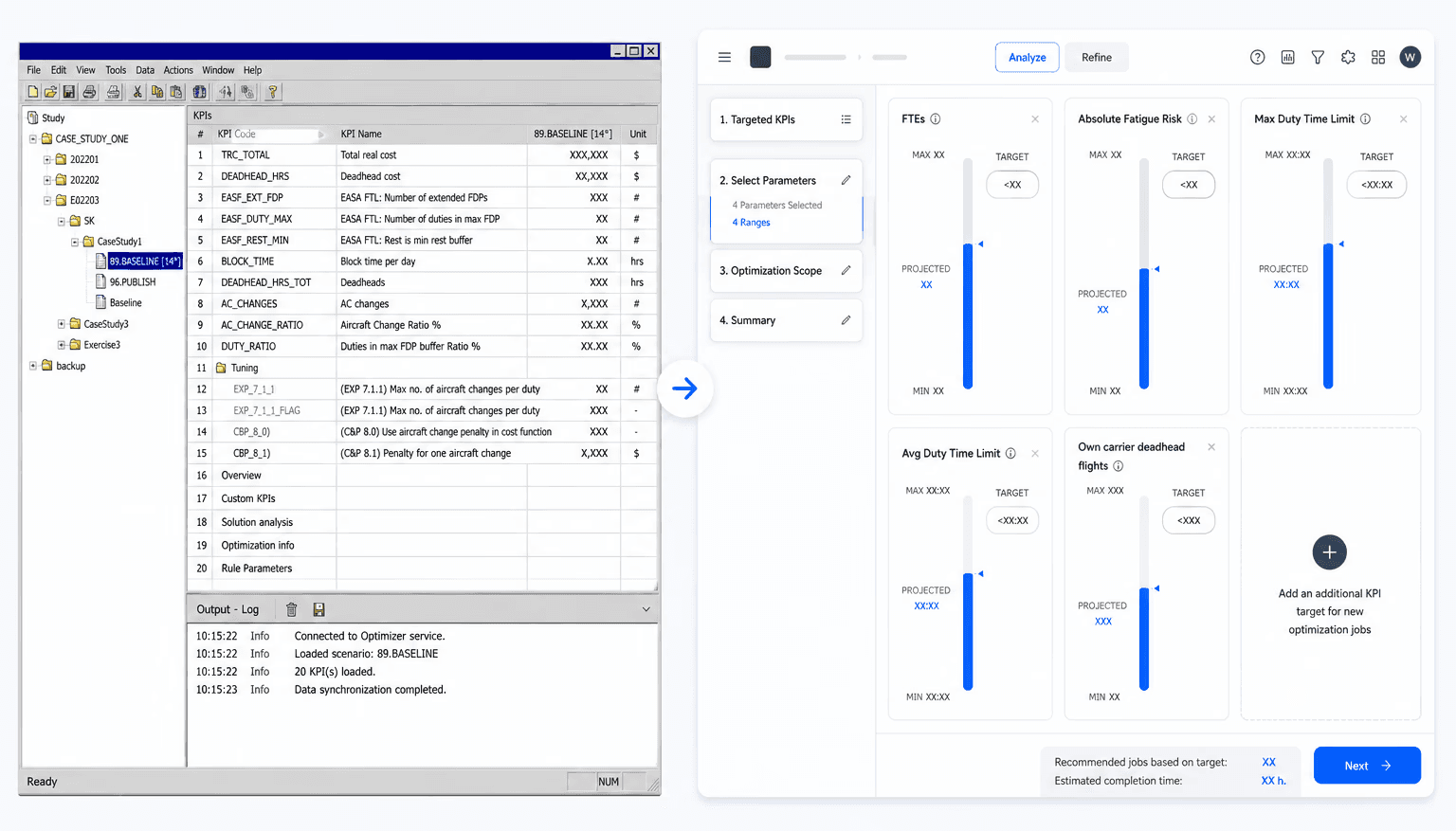
The design move was simple to describe and consequential to commit to: invert the order of the conversation. Instead of starting with parameters and hoping the KPIs land somewhere acceptable, start with the KPIs and let the system propose how to get there.
Before, legacy logic
User configures, then sees the result
Pick parameters from a flat list of 2,000+
Guess values from memory or trial-and-error
Launch, wait, inspect KPIs
If unsatisfied, adjust and repeat
Knowledge lives in expert heads
After, KPI-driven optimization
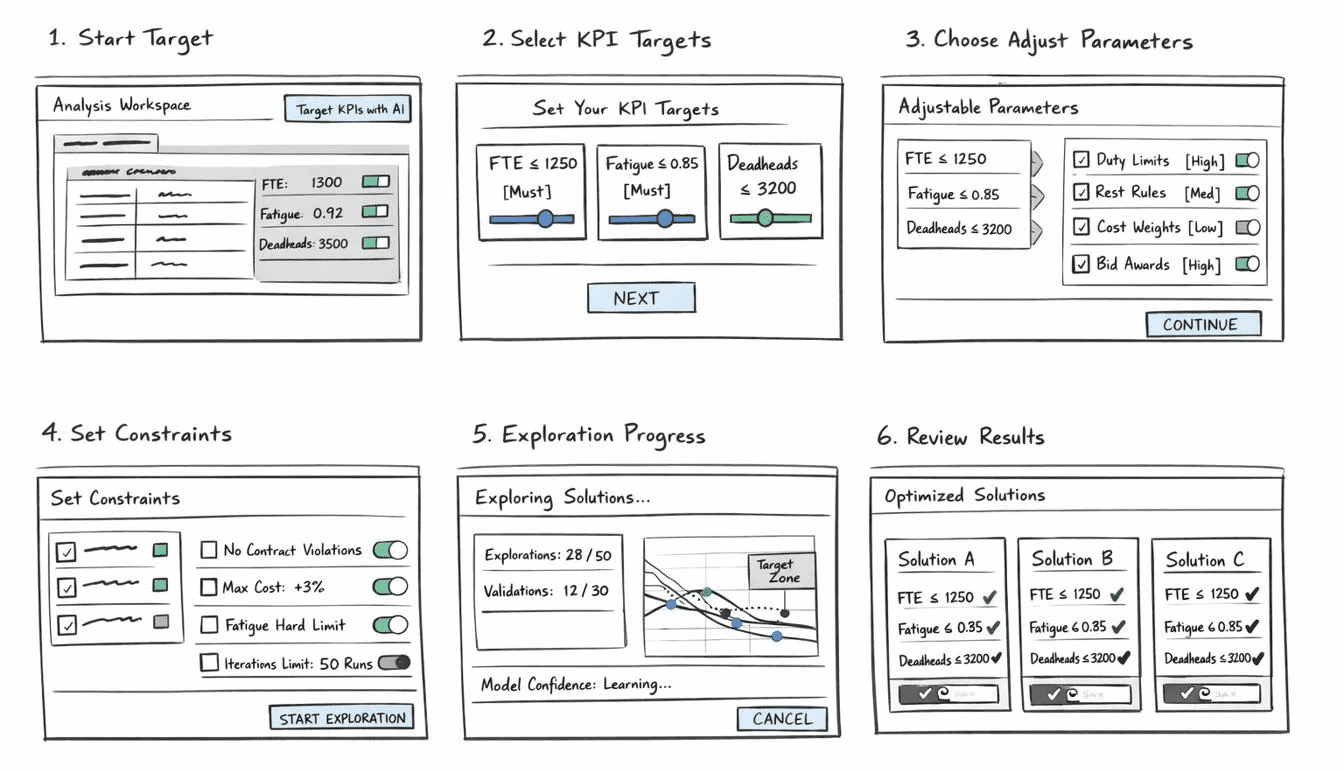
User sets the goal, system proposes the path
Define ranges and targets on the KPIs that matter
System recommends correlated parameters
User approves the search space
Optimizer explores; user gets a set of trade-off-able solutions
Knowledge accumulates in the system
Translated into a flow, the experience became four sequential steps, each designed to keep the planner in control of intent while removing the burden of mechanics.
Three principles that held the work together
"The human owns intent. The system owns search."
Split responsibility between human and AI
The planner decides what counts as a good outcome and what's negotiable. The system handles the combinatorial work of finding configurations that satisfy that brief. This split isn't just operational. It's where trust is built. Users stay in control of decisions they're accountable for; the AI takes on work no human should be doing by hand.
"Correlation is shown, not enforced. The AI advises; the human commits."
Surface model knowledge without replacing judgement
The system surfaces which parameters historically move which KPIs (high, medium, low correlation). But the planner picks. A senior analyst can override the recommendation when they know context the model doesn't. No black-box decisions, no forced trust.
"It plugs into the workflow that already works."
Connect, don't replace
KPI-driven optimization isn't a parallel product or a separate mode. Results land directly back in the Analyse workspace built in Phase 1: same comparison tools, same trade-off charts, same publish workflow. Two phases, one continuous workflow.
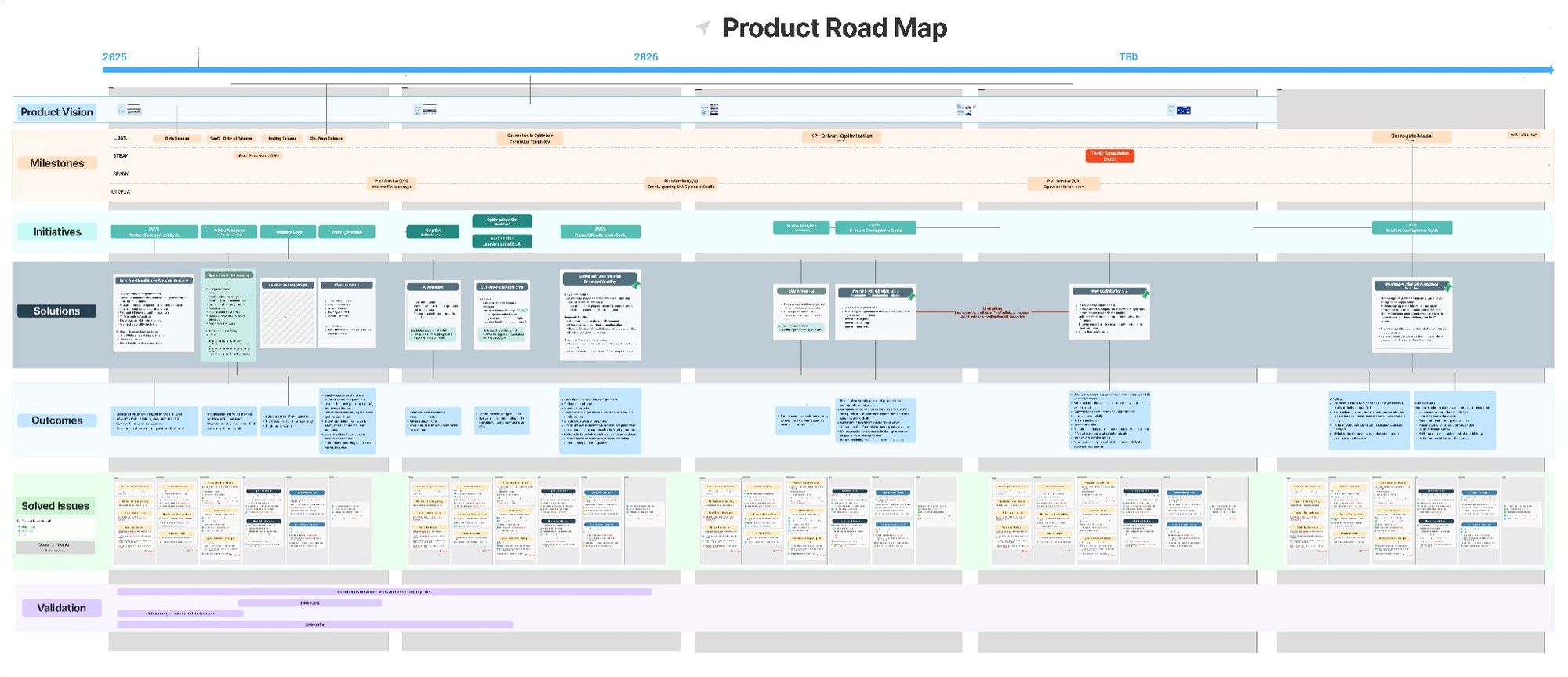
The wider product roadmap. KPI-driven optimization sits between the shipped JAWS Phase 1 and the longer-horizon Surrogate Model work. Each phase builds on the layer below it, with customer validation cycles planned at every step.
05 Outcome
A direction the organisation could commit to
~80%
projected reduction in configuration time per planning cycle
2k → ~5
parameters the planner directly interacts with, from list to KPIs
Long-term
planning made tractable, seasonal and contract scenarios become explorable
By the end of discovery, KPI-driven optimization had moved from a recurring complaint into a cross-portfolio initiative with a defined place on the roadmap, with four product teams aligned behind one direction. The work produced four concrete outputs the wider organisation could build against:
A five-to-seven day process becomes a single guided session: the planner negotiates targets, reviews proposals, and publishes a defensible result.
01
02
What it took
The work here was mostly framing, not wireframes. Convincing a room that the answer wasn't more AI, it was a cleaner split between what the planner decides and what the system searches for. Getting UX, product, engineering and portfolio leadership to commit to one direction, and leaving them a roadmap they could build against, mattered more than any single screen.
The hard part wasn't proposing the idea. It was making it defensible: a four-step model the optimization research team could design a surrogate model around, and a success framework agreed before anyone wrote code. Direction first, build second.
06 Reflection
On designing for the part of AI that isn’t visible
The hardest part of this project lived upstream of any screen. Getting the organisation to recognise that the right intervention wasn't more parameters, better tooltips, or smarter defaults, but a different conversation between the user and the system. When the obvious answer in the room is "just add more AI", the most valuable design work is often deciding what control needs to stay with the human, and why.
"The optimizer was always capable of doing the search. The shift wasn't technical. It was giving users a language to ask for what they wanted, and a way to trust what came back."
What I take from this project is how much of an AI-assisted workflow lives in the structure around the model, not the model itself. The surrogate model is powerful, but it only becomes useful when the user can express what they want, see what the system is proposing, and stay in the loop on every consequential decision. That's where UX earns its place: not by polishing the surface, but by deciding where the seams between human and machine actually go.